
The Carbon Border Adjustment Mechanism (CBAM) is becoming an increasingly important consideration for businesses importing carbon-intensive goods into the UK and EU.
The EU’s definitive CBAM regime came into effect on 1 January 2026, while the UK’s own CBAM is due to follow from 1 January 2027. Although the two schemes share the same broad objective, there are some important differences in how they will operate.
For businesses trading across the UK and EU, understanding those differences could be essential for determining whether CBAM applies and what needs to be done to prepare.
What is CBAM?
CBAM is designed to tackle carbon leakage – where production moves to countries with less stringent climate policies to avoid the carbon costs faced by domestic producers.
Rather than reducing global emissions, this can simply shift them elsewhere.
CBAM addresses this by placing a carbon price on the embedded emissions associated with certain carbon-intensive imported goods. The intention is to create a more level playing field between imported products and goods manufactured domestically under an Emissions Trading Scheme (ETS).
The UK and EU schemes aren’t identical
While the UK CBAM and EU CBAM follow similar principles, businesses shouldn’t assume that complying with one automatically means complying with the other.
There are differences in areas including:
- the sectors and products covered;
- the thresholds used to determine whether CBAM applies;
- carbon pricing;
- reporting frequency;
- the treatment of indirect emissions; and
- how CBAM liabilities are paid.
For example, the EU threshold is based on the weight of in-scope products, whereas the UK scheme will use a £50,000 value threshold over a 12-month period. The EU scheme also includes electricity within its applicable sectors, while the UK scheme does not.
These differences mean that a business could potentially fall within the scope of one regime but not the other.
What should businesses be doing now?
With the EU’s definitive regime already underway and the UK CBAM approaching in 2027, businesses that import potentially affected goods should start establishing whether their products fall within scope.
Commodity codes will be particularly important and should be checked against each scheme separately.
Businesses operating across both markets should also avoid assuming that emissions calculations prepared for one CBAM regime will automatically be acceptable for the other. Methodologies and default values will need to be considered separately.
Where actual embedded emissions data is used, verification requirements also need to be considered, including the requirement for appropriately accredited independent verification.
Download our free EU vs UK CBAM comparison
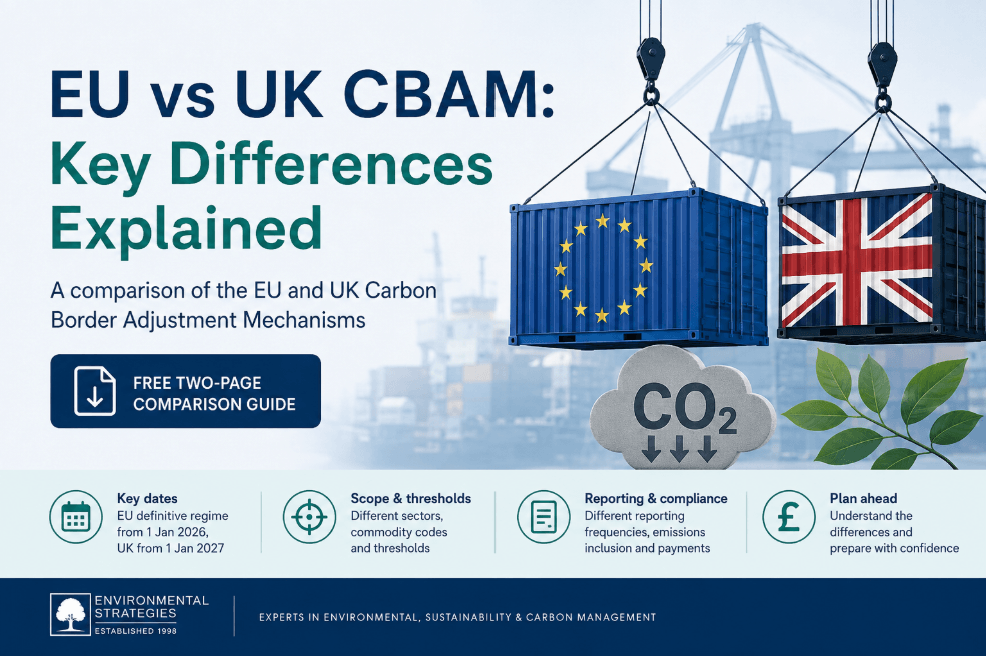
To make the differences easier to understand, we’ve produced a free two-page EU vs UK CBAM Comparison Overview.
It provides an at-a-glance comparison of the two schemes, including their effective dates, applicable sectors, thresholds, reporting requirements, treatment of emissions and payment mechanisms.
Download your free copy of our EU vs UK CBAM Comparison Overview below.
Need help understanding your carbon reporting requirements?
Environmental Strategies Ltd supports businesses with carbon accounting, emissions data and wider environmental and sustainability requirements.
If you’re unsure how CBAM may affect your organisation, or need support understanding and calculating the emissions associated with your operations or products, get in touch with our team to discuss how we can help.